


When Cybersecurity Gets Physical
When we think about cybersecurity threats, we typically imagine network intrusion, sophisticated phishing campaigns, zero-day software exploits, and malware pipelines. However, one of the most fascinating and alarming domains of security research involves physical side-channel attacks. In a landmark study, researchers demonstrated that an attacker can extract 4096-bit RSA decryption keys from a laptop simply by listening to the faint, high-pitched sound produced by its internal electronics.
This article provides an in-depth breakdown of acoustic cryptanalysis for both non-technical readers and seasoned security engineers, exploring how computers sing their secrets, why traditional physical defenses like Faraday cages fail, and how modern software countermeasures protect our encryption system.
1. The Research Team Behind the Breakthrough
This pioneering work, titled “RSA Key Extraction via Low-Bandwidth Acoustic Cryptanalysis,” was conducted by a world-renowned team of cryptographers and security researchers:
- Daniel Genkin (Technion and Tel Aviv University)
- Adi Shamir (Weizmann Institute of Science — co-inventor of the RSA cryptosystem)
- Eran Tromer (Tel Aviv University and Boston University)
The researchers were assisted by Lev Pachmanov, who contributed extensively to the software setup and signal acquisition tools, as well as Avi Shtibel, Ezra Shaked, Oded Smikt, and Assa Naveh for experimental design and configuration, alongside editorial advisor Sharon Kessler. They also collaborated closely with Werner Koch, the lead developer of GnuPG, to implement robust software countermeasures.
Originally disclosed in late 2013 and presented at CRYPTO 2014, this research earned the prestigious Pwnie Award for Most Innovative Research at Black Hat 2014 and was published in the Journal of Cryptology.
2. How It Works: For Non-Techies (The “Engine Hum” Analogy)
Have you ever noticed a faint whining or buzzing sound coming from your laptop when it is working hard? Most people assume that noise is just the cooling fan or a spinning hard disk. In reality, much of that high-pitched hum comes directly from your computer’s electronic electrical circuitry — specifically the voltage regulator.
To understand how an attacker can steal encryption keys from sound, think of your computer’s processor like a car engine:
- Different tasks require different throttle levels: When your computer decrypts a secure email or file, it performs millions of intense mathematical calculations.
- The power delivery system adjusts constantly: To feed the processor a steady voltage during these bursts of calculation, tiny components called capacitors and coils (inductors) in the voltage regulation circuit contract and expand slightly due to electromechanical forces.
- Vibrations turn into sound waves: These physical vibrations push against the surrounding air, generating a faint acoustic noise — often at ultrasonic frequencies between 10 kHz and 40 kHz.
Because different secret encryption keys force the processor to execute slightly different mathematical patterns, each key produces a distinct acoustic melody. By recording that hum with a microphone and analyzing it, researchers showed that it is possible to reconstruct the secret key bit by bit.
3. Under the Hood: For Techies & Security Engineers
For cybersecurity practitioners and systems engineers, this low-bandwidth acoustic side channel reveals critical insights into physical leakage and implementation weaknesses in cryptographic libraries.
The Acoustic Side-Channel Mechanism
The target of the research was GnuPG 1.x (and the underlying libgcrypt library used in GnuPG 2.x) executing 4096-bit RSA decryption. While individual CPU instructions operate at gigahertz (GHz) clock rates — far too fast for conventional microphones to resolve — modular exponentiation routines take milliseconds to execute, producing distinct spectral signatures in the acoustic domain.
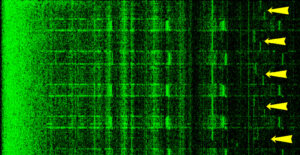
During an RSA decryption using the Chinese Remainder Theorem (CRT), GnuPG performs modular exponentiation first modulo the secret prime p, and then modulo the secret prime q. This transition produces a clear spectral shift halfway through the decryption sequence that is easily visible on an acoustic spectrogram.
Adaptive Chosen-Ciphertext Attack (CCA)
To extract individual secret key bits rather than merely distinguishing keys, Genkin, Shamir, and Tromer designed an adaptive chosen-ciphertext attack:
- Automated Decryption Triggers: An attacker sends crafted OpenPGP/MIME encrypted messages to a victim’s email client equipped with an auto-decrypting plugin (such as Enigmail in Thunderbird).
- Bitwise Leakage Amplification: Each ciphertext is mathematically structured so that when GnuPG processes a specific bit of the secret key, the resulting power draw produces a distinct acoustic frequency peak depending on whether the bit is 0 or 1 (for instance, a strong component at 2 kHz for a 0 versus 38.1 kHz for a 1).
- Iterative Extraction: An automated signal classification script records the acoustic emanation, classifies the bit, and generates the next ciphertext. A complete 4096-bit RSA decryption key can be extracted in under an hour.
Attack Vectors and Range Comparison
| Attack Vector / Scenario | Effective Range | Required Equipment | Real-World Threat Profile
|
| Mobile Phone Eavesdropping | Up to 30 cm (~1 foot) | Commodity smartphone with audio recording app | An infected or planted smartphone placed on a meeting desk next to the target laptop. |
| Parabolic Microphone | Up to 4 meters (~13 feet) | Directional parabolic microphone dish & digitizer | Surveillance across a room, classroom, or from an adjacent office cubicle. |
| Browser-Based Exfiltration | Zero physical access | HTML5 Media Capture or Flash microphone access | A malicious website or chat application tricking the user into granting microphone access. |
| Chassis Ground Potential | Direct touch / Cable end | Oscilloscope or VGA/USB/Ethernet ground wire | Measuring electrical ground fluctuations via bare hand touch or remote shielding lines. |
4. Why Standard Defenses (Even Faraday Cages) Fall Short
One of the most sobering conclusions of this research is that many traditional physical security measures offer zero protection against acoustic cryptanalysis:
- Air-Gapped Workstations: Isolating a computer from all network interfaces does not prevent acoustic signals from traveling through the air to a nearby microphone or compromised smartphone.
- TEMPEST / Faraday Cage Shielding: Sensitive government and military facilities often place workstations inside Faraday cages to block compromising electromagnetic radiation. However, high-performance computers require airflow. Ventilation panels covered with perforated metal honeycomb mesh effectively block RF waves but are almost entirely transparent to sound waves.
5. How to Protect Your Systems
The researchers responsibly disclosed their findings to the developers of GnuPG under CVE-2013-4576. Modern countermeasures address the problem at both the software and hardware levels:
Software and Algorithmic Mitigations (Primary Defense)
The most practical and cost-effective way to prevent side-channel key extraction is to modify the cryptographic algorithms so that their physical emissions carry no useful information:
- Ciphertext Blinding: Before performing modular exponentiation, the software multiplies the ciphertext by a random secret blinding factor. This randomizes the sequence of operations performed by the CPU, breaking the correlation between the chosen ciphertext and the acoustic signature.
- Constant-Time Execution: Designing cryptographic primitives so that execution paths and memory access patterns remain independent of secret inputs.
Hardware and Environmental Controls
- Acoustic Attenuation: Employing soundproofing enclosures or wideband acoustic masking noise in high-security facilities.
- Low-Noise Component Selection: Designing power delivery circuits with low-vibration capacitors and acoustically dampened inductors.
- Device Hygiene: Prohibiting smartphones, smart speakers, and personal IoT devices from being placed near sensitive cryptographic workstations.
6. Key Takeaways
The acoustic cryptanalysis research by Genkin, Shamir, and Tromer reminds us that cryptography does not run in a mathematical vacuum — it runs on physical hardware that consumes energy, radiates heat, and vibrates. Whether you are managing cloud infrastructure, developing secure applications, or auditing enterprise security, remember that physical side channels can bypass even the strongest encryption algorithms if software implementations are not hardened.
Always ensure your cryptographic libraries (including GnuPG, OpenSSL, and libgcrypt) are up to date with modern side-channel protections, and maintain strict physical security protocols around sensitive key-management infrastructure.